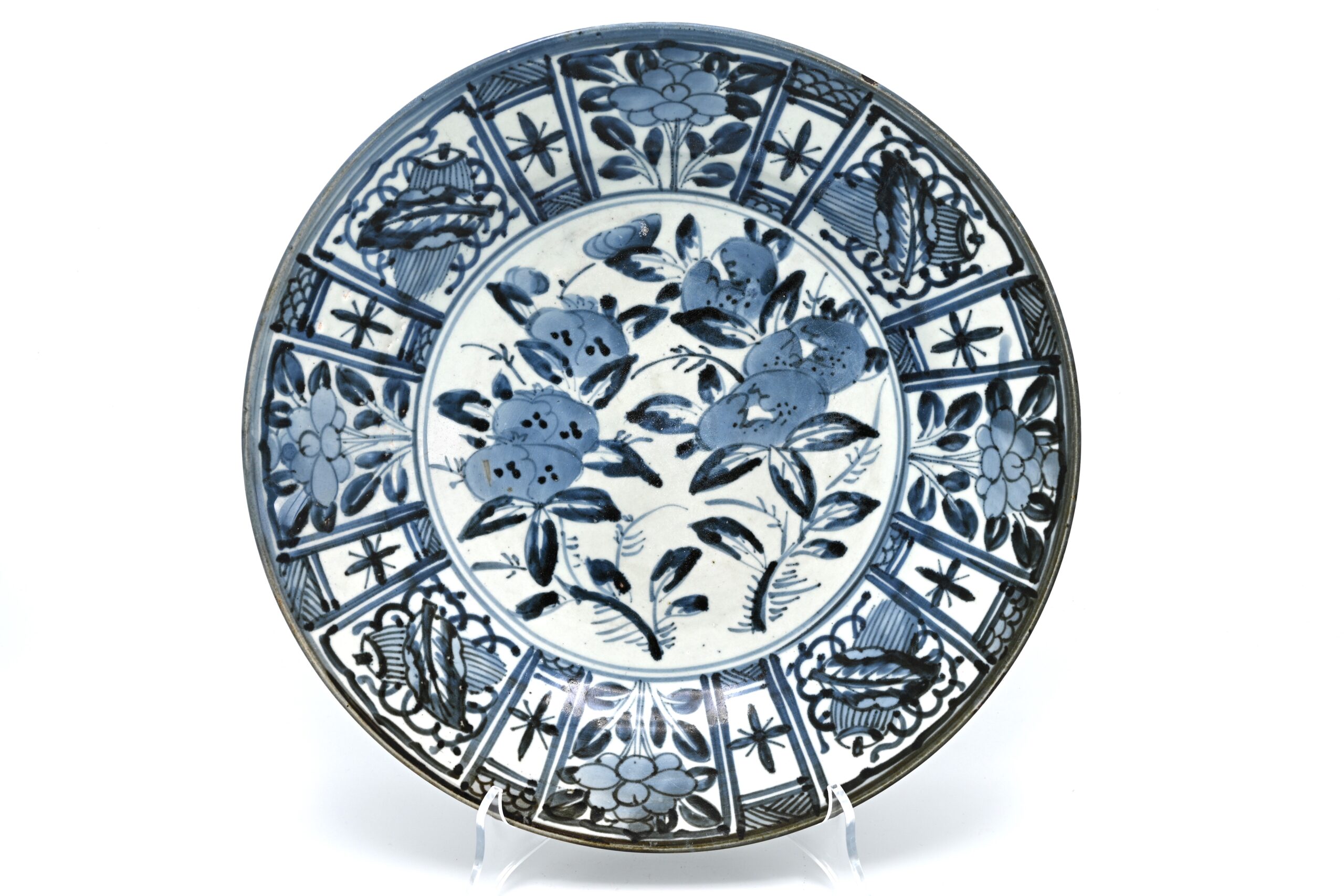
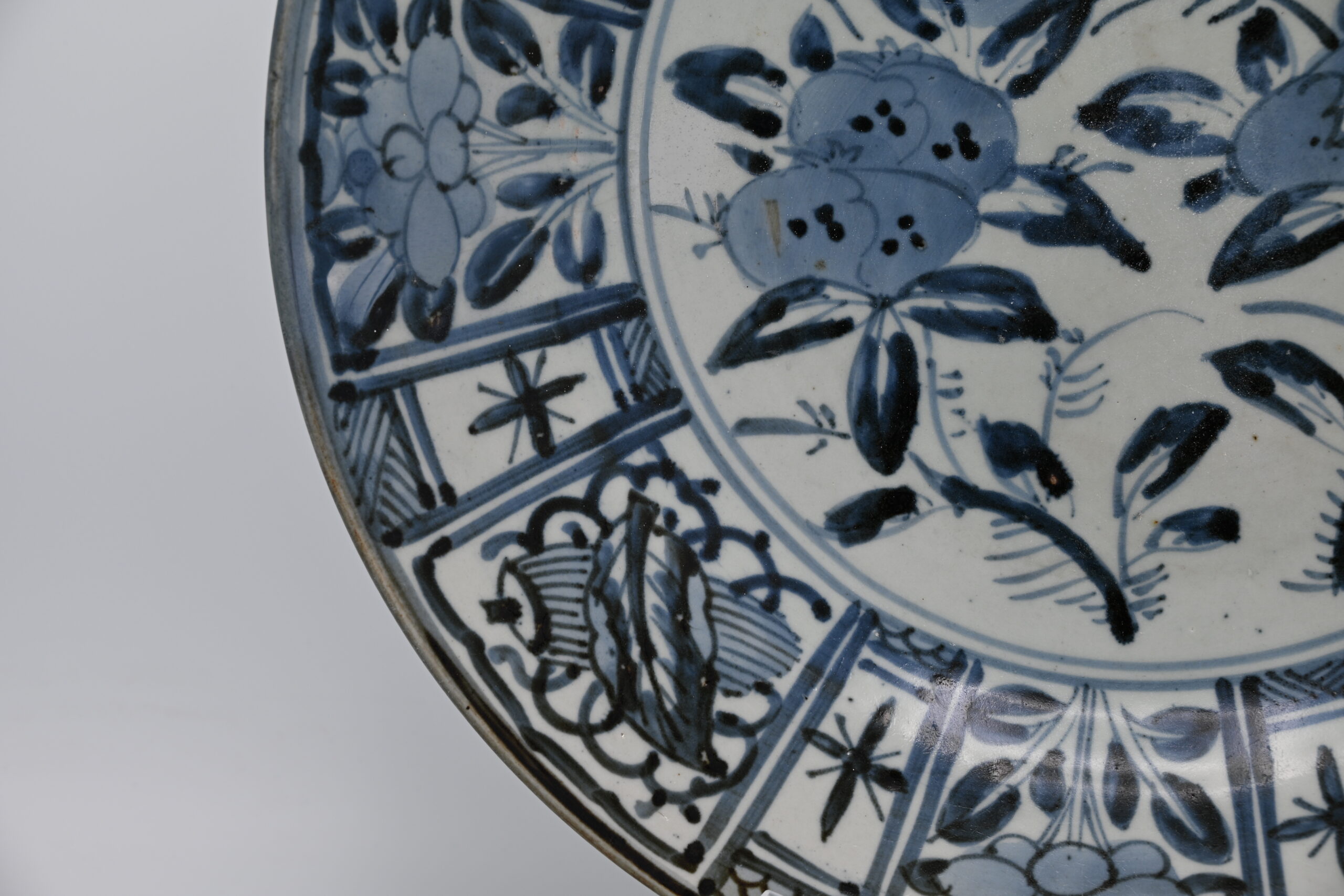
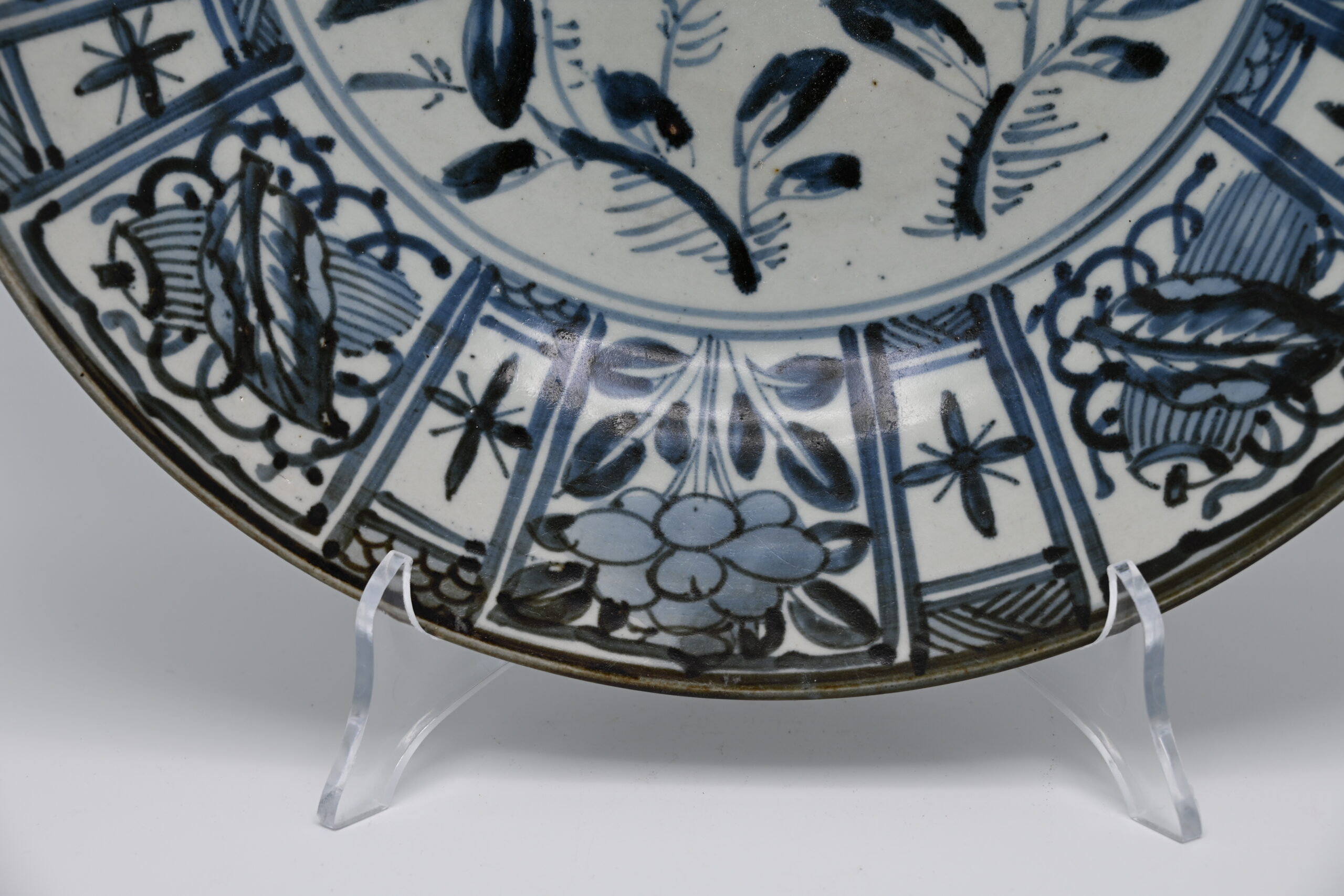
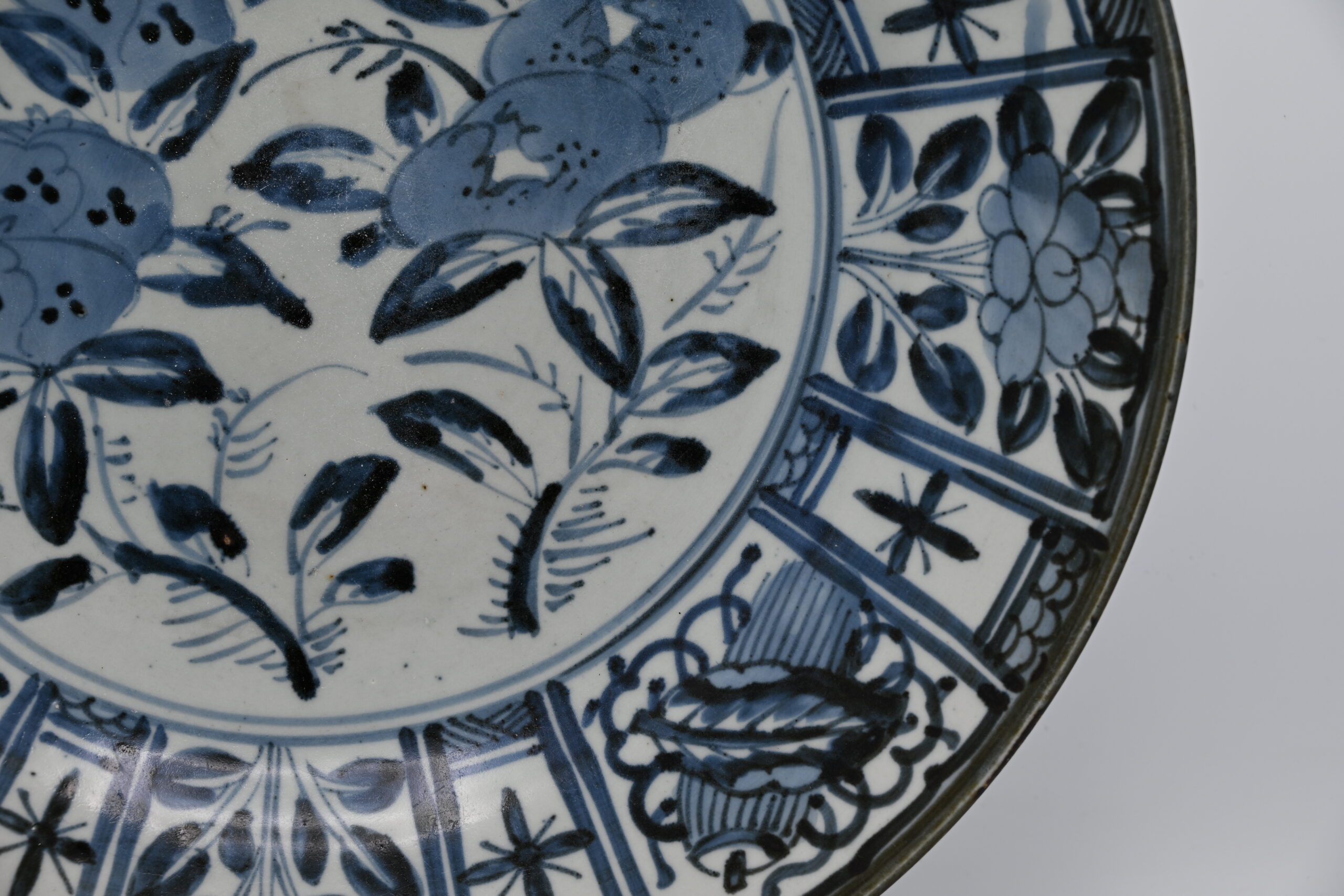
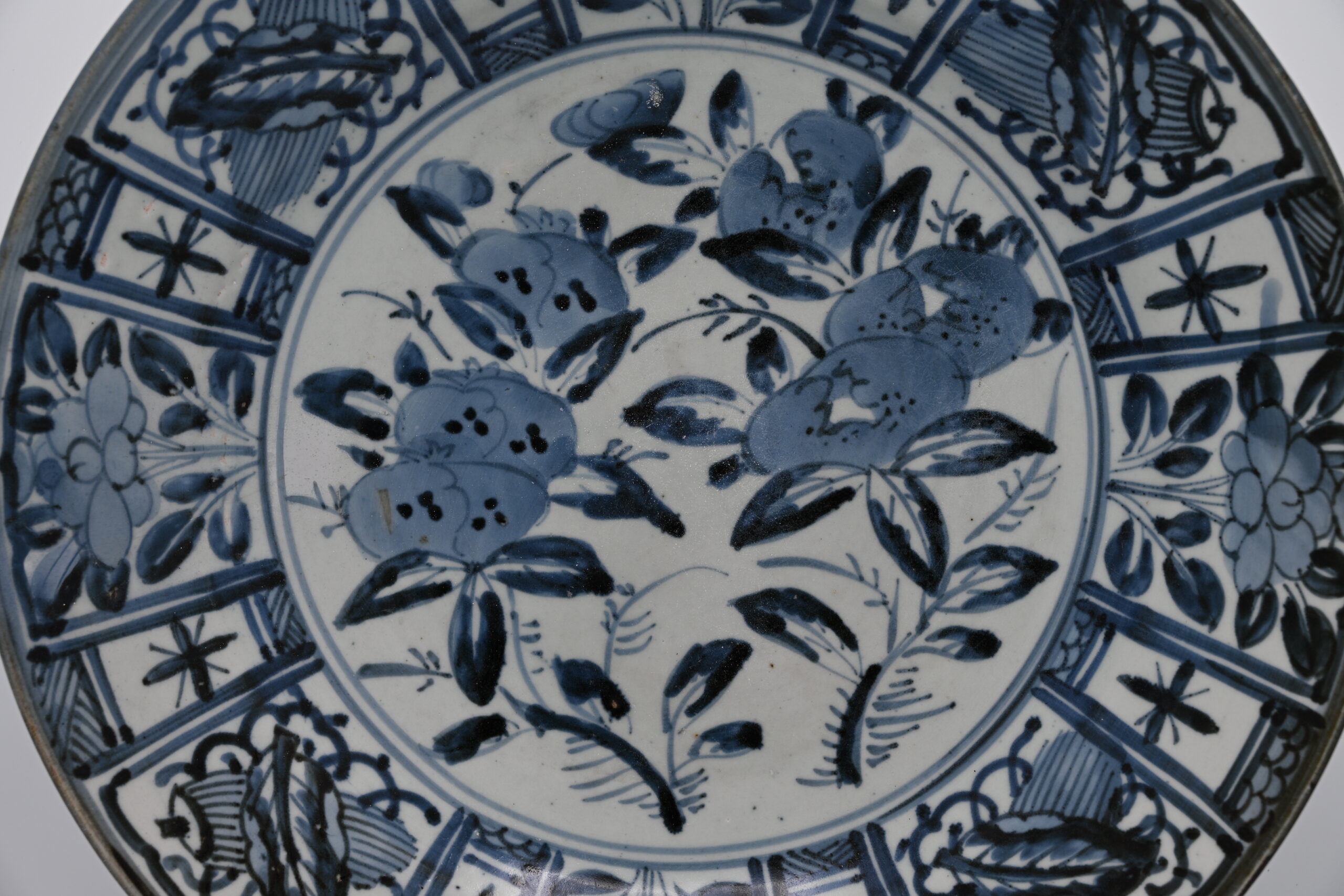
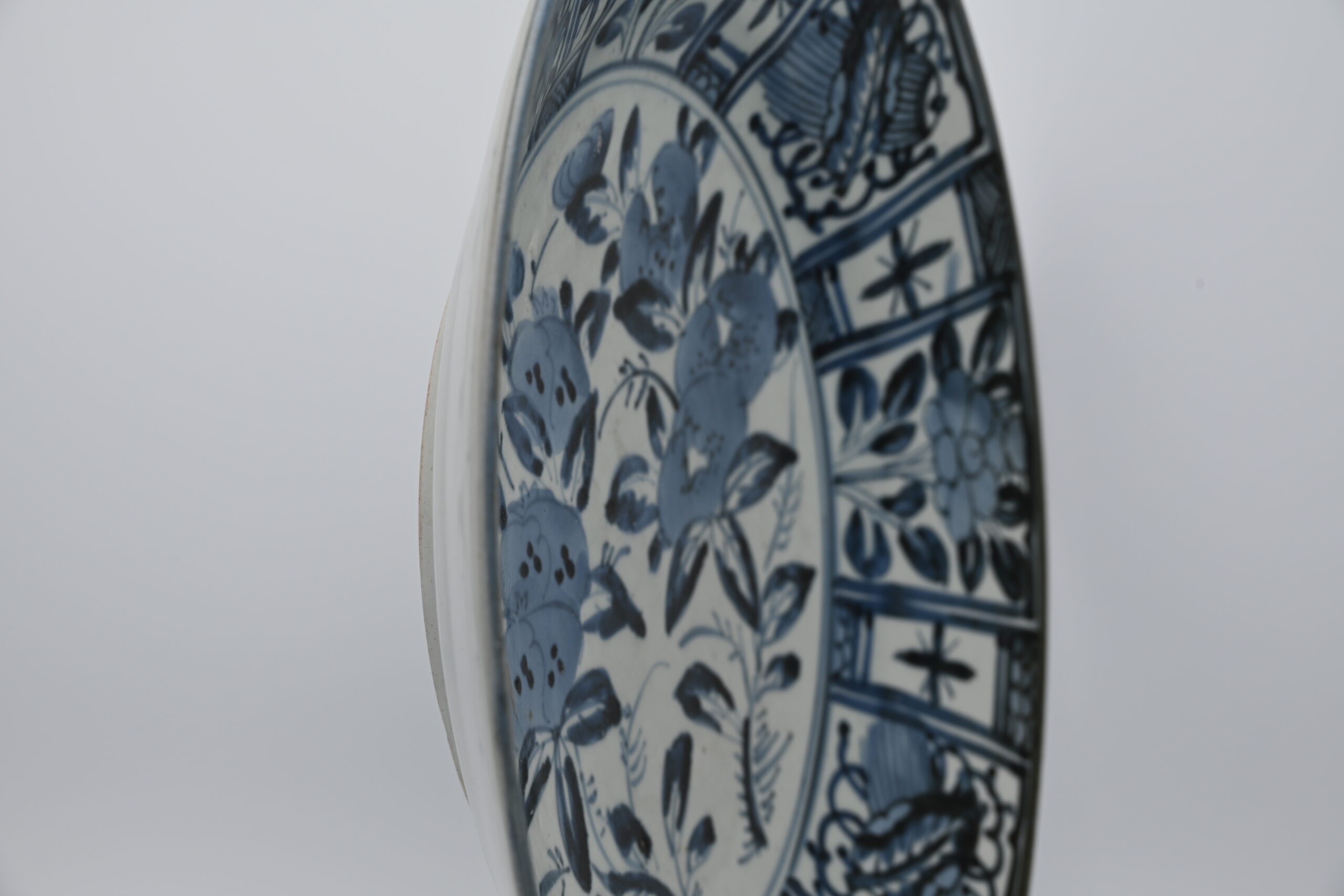
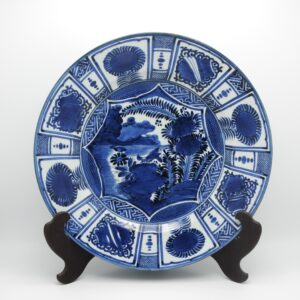
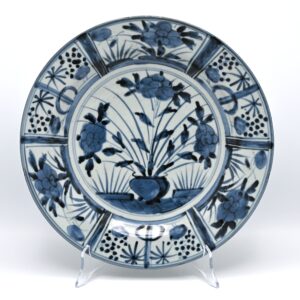
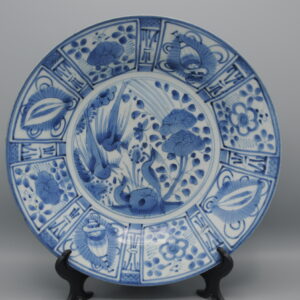
A large Japanese Arita blue and white porcelain dish depicting pomegranates, dating from the late seventeenth century, Edo period, circa 1670–1690.
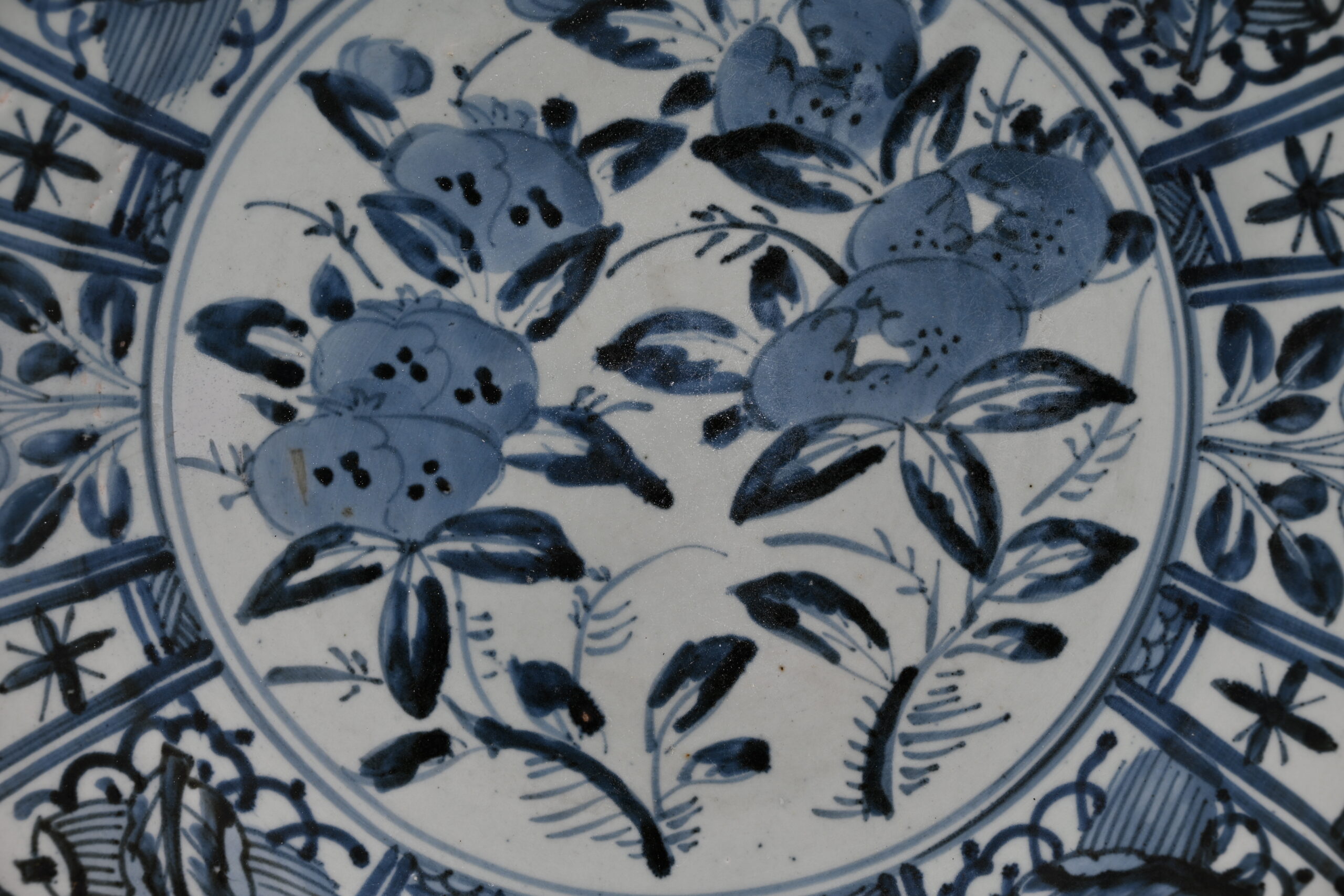
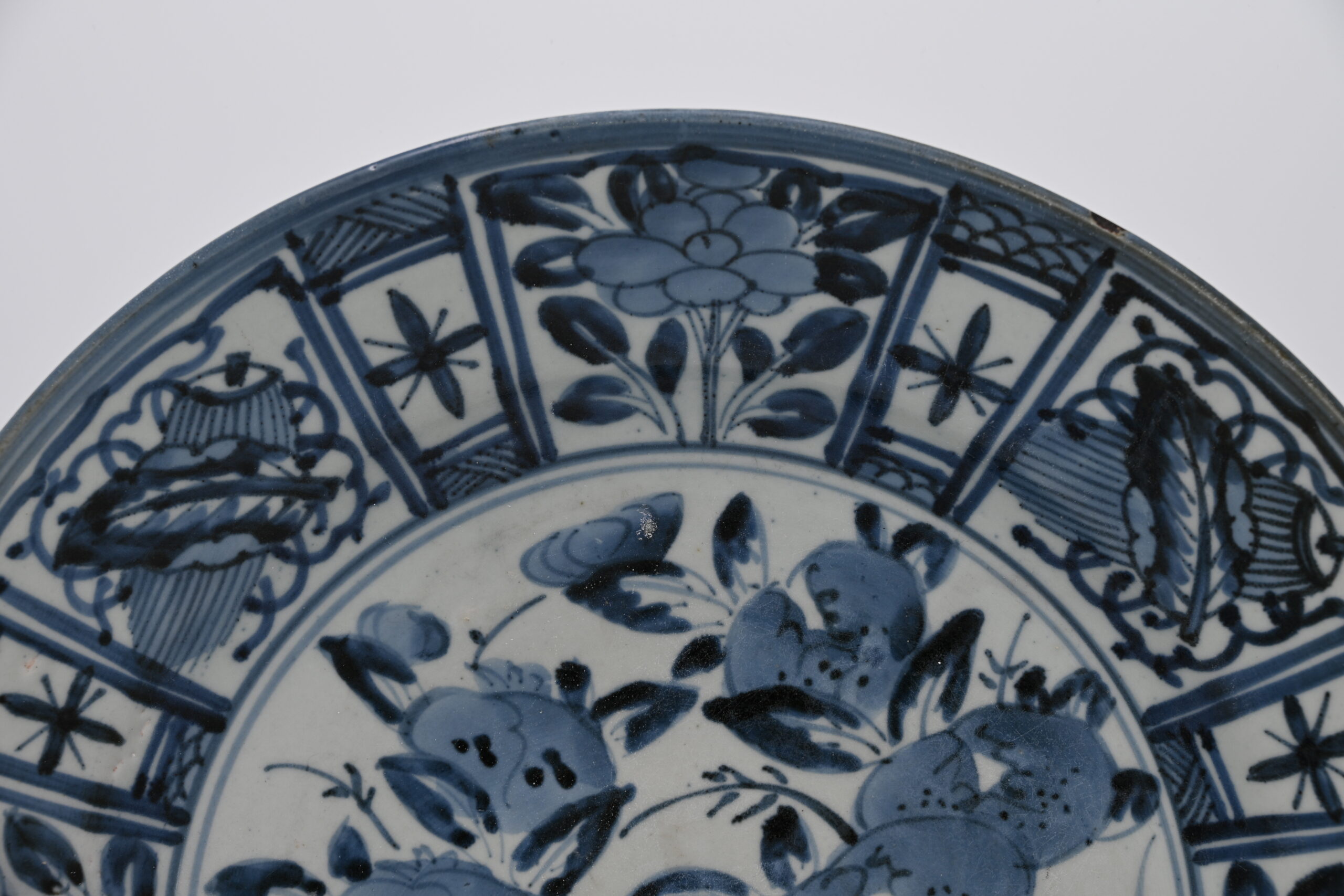
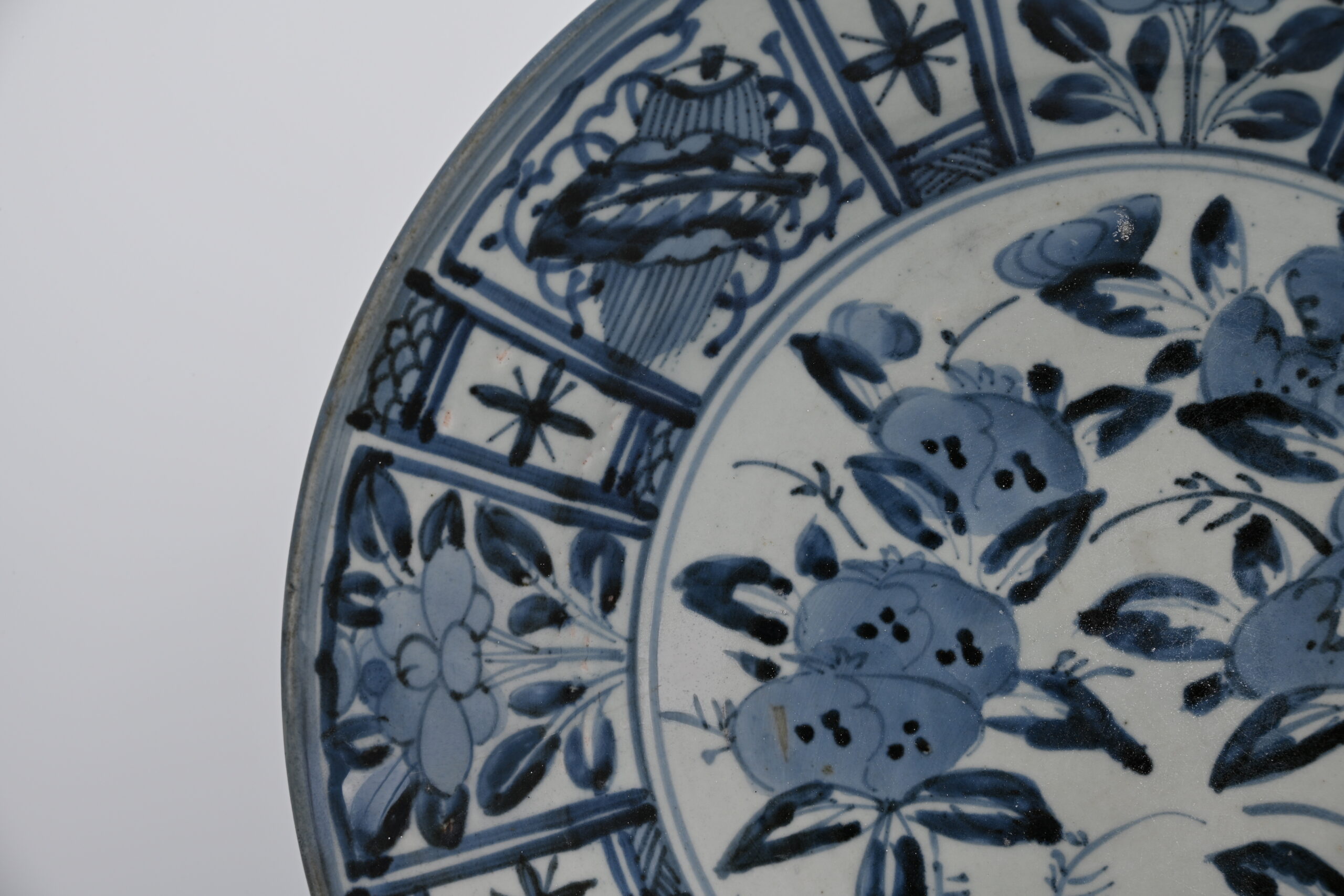
The centre is painted in underglaze cobalt blue with two spreading fruiting branches, one bearing pomegranates and the other fingered citrons, commonly known as Buddha’s Hand. The broad rim is divided into alternating Kraak-style panels containing stylised peonies and auspicious objects, separated by narrower compartments filled with florets.
The composition combines two important Chinese sources. The panelled border derives from Chinese Kraak porcelain of the late Ming period, while the more freely arranged fruiting branches relate to Chinese Transitional and early Kangxi porcelain. Japanese potters at Arita combined these elements into a distinctive decorative scheme produced in several sizes for the export market during the second half of the seventeenth century.
The imagery also carried auspicious meaning. The many-seeded pomegranate traditionally symbolised fertility and numerous descendants, while Buddha’s Hand citron was associated with happiness and good fortune. Together with the peach, these fruits formed the Chinese group known as the Three Abundances.
Size
Diameter: 33 cm (13 in.)
Condition
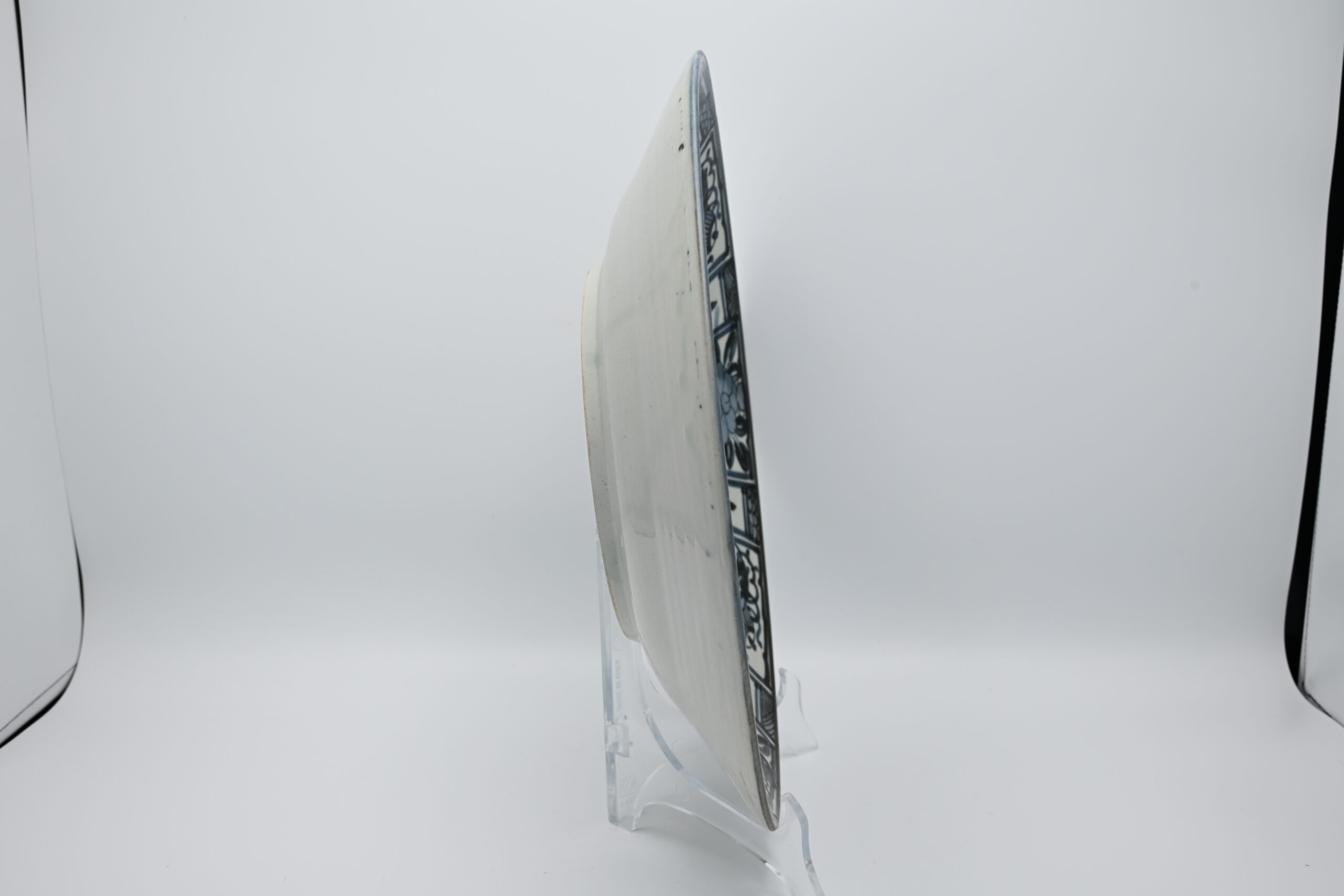
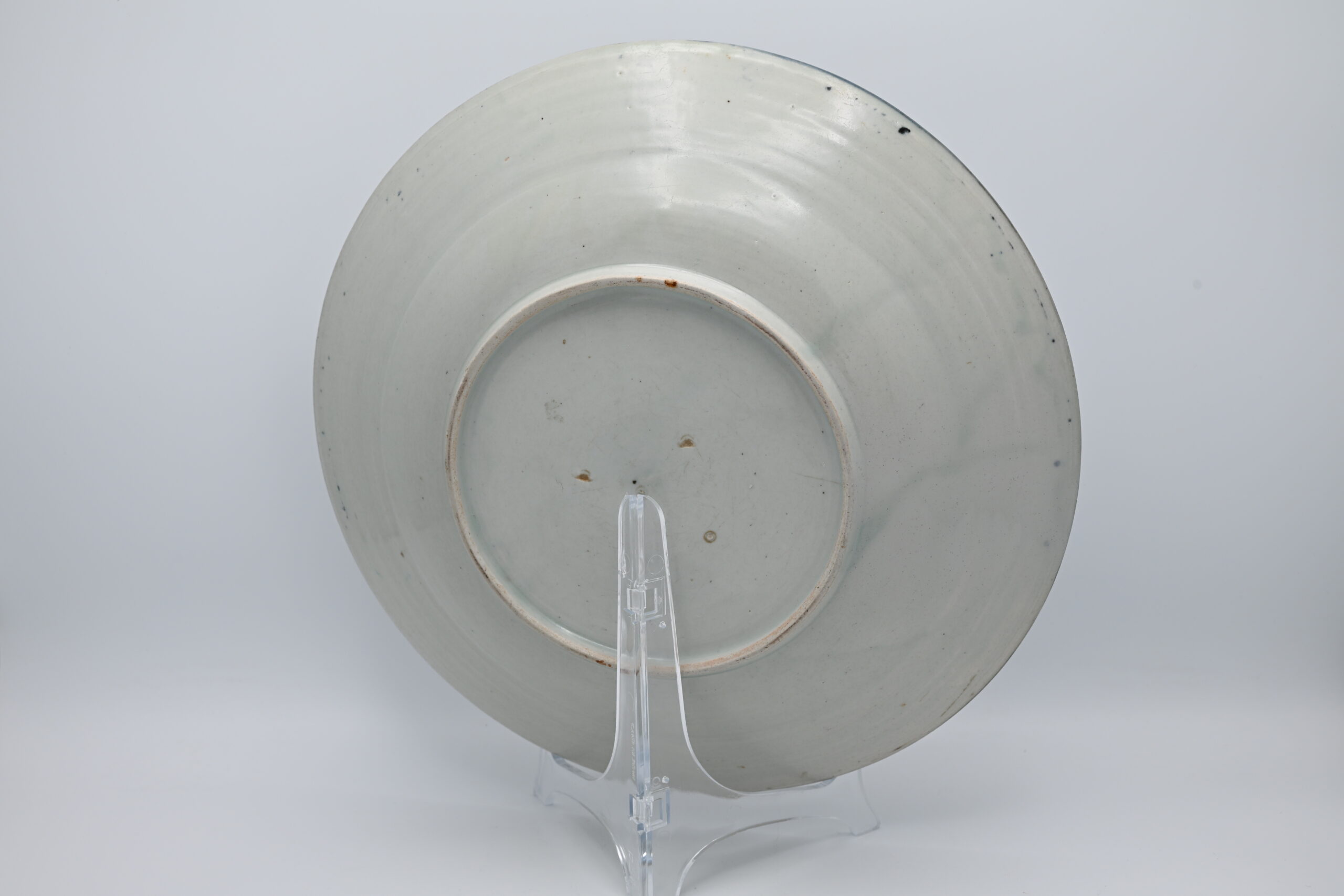
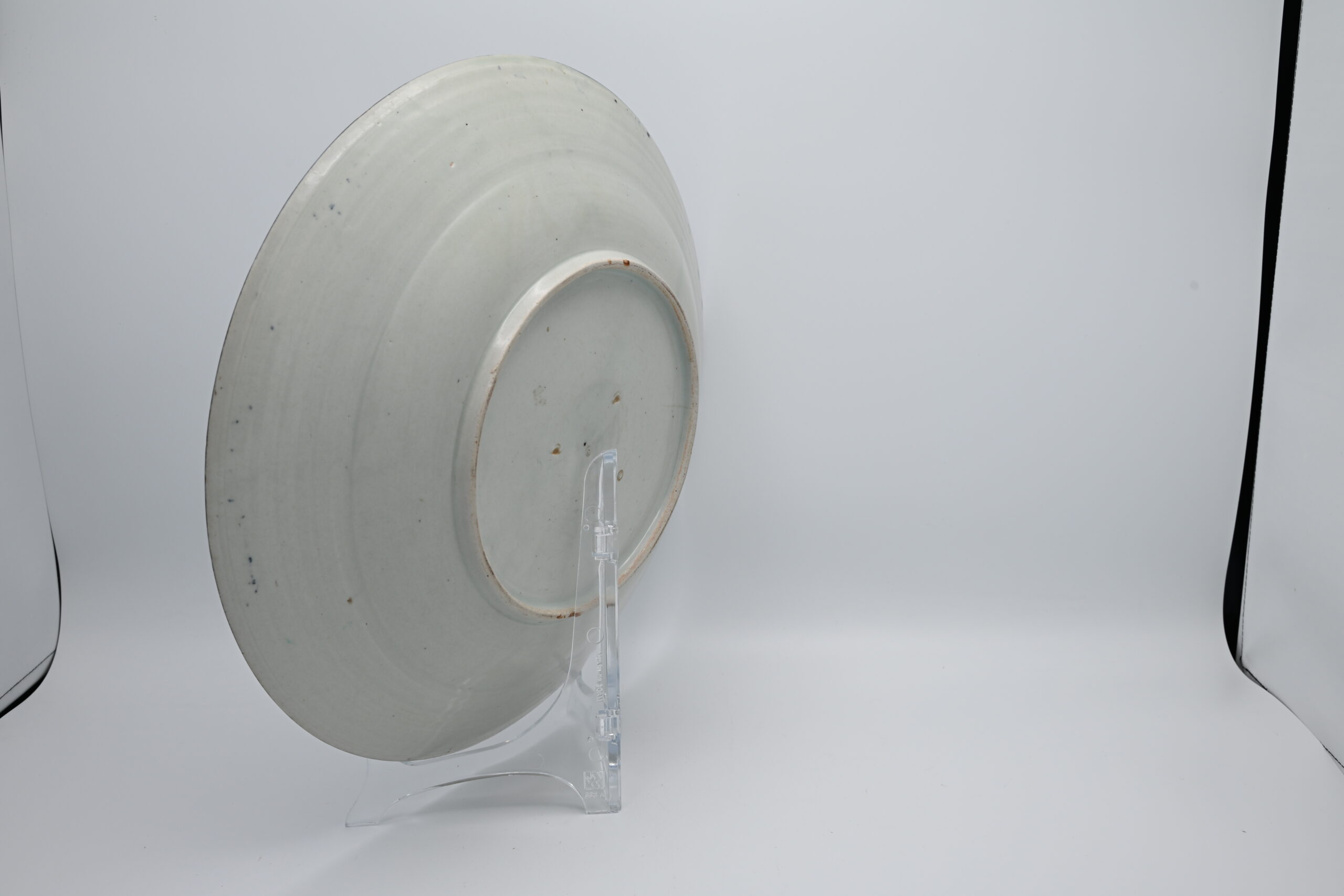
In good condition, with minor firing irregularities consistent with age and production. Please refer to the photographs for a detailed assessment
Comparative literature
- D.F. Lunsingh Scheurleer, “Japans porselein met blauwe decoraties uit de tweede helft van de zeventiende en de eerste helft van de achttiende eeuw,” Mededelingenblad Nederlandse Vereniging van Vrienden van de Ceramiek, nos. 64–65, 1971, p. 54, cat. 8.
- C.S. Woodward, Oriental Ceramics at the Cape of Good Hope 1652–1795, Cape Town and Rotterdam, 1974, pp. 20–21, cat. 26b.
- Soame Jenyns, Japanese Porcelain, Faber & Faber, London and Boston, 1979, cat. 16a.
- S. Hartog, Pronken met Oosters porselein, exhibition catalogue, Gemeentemuseum Arnhem, Waanders, Zwolle, 1990, p. 128, cat. 153.
- Filip Suchomel and Marcela Suchomelová, Masterpieces of Japanese Porcelain, National Gallery, Prague, 1997, p. 77, cat. 25.
- Oliver Impey, Japanese Export Porcelain: Catalogue of the Collection of the Ashmolean Museum, Oxford, Hotei Publishing, Amsterdam, 2002, p. 109, cat. 128.
- Christiaan J.A. Jörg, Fine & Curious: Japanese Export Porcelain in Dutch Collections, Hotei Publishing, Amsterdam, 2003, p. 28, cat. 8.
- Complete Catalogue of the Shibata Collection, Kyushu Ceramic Museum, 2003, p. 332, cat. 2595.